Tactic #11 — Using the Children
This is the eleventh of 16 blogs discussing the patterns of tactics from my power and control wheel — Using the Children.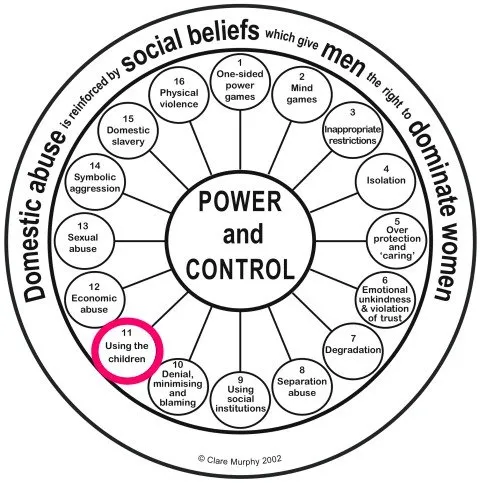 Ways men use the children to maintain power and control or to punish their partner or ex-partner include demanding that she do all the childcare, making her feel guilty about the children, telling her he wouldn’t lose his temper if she kept the children quieter. Some men undermine her relationship with the children, for example when she sets clear boundaries he will then tell the children they’re allowed to do the thing their mother had said ‘no’ to. Some men also undermine her parenting by telling her she’s a bad parent and by purposefully belittling her in front of the children.
Ways men use the children to maintain power and control or to punish their partner or ex-partner include demanding that she do all the childcare, making her feel guilty about the children, telling her he wouldn’t lose his temper if she kept the children quieter. Some men undermine her relationship with the children, for example when she sets clear boundaries he will then tell the children they’re allowed to do the thing their mother had said ‘no’ to. Some men also undermine her parenting by telling her she’s a bad parent and by purposefully belittling her in front of the children.
Some men use the children by threatening to take them away or kidnap them if his partner leaves him, or they threaten to have the children taken into care of child protection services or they threaten to harm the children, or actually do harm the children.
Women with children are more likely to be abused by their partner than are women without children.1 When men do abuse their partner this increases the likelihood he will abuse the children — physically, sexually, psychologically. And the more frequent the abuse towards their partner, the higher the chance the children will be abused too.2
Many men who coercively control their partner use children as weapons to get at her, control her, and keep her in her place.
Quite soon after starting her relationship with Luke, Heather did not want to be with him because he was abusing her. She wanted to leave and do her teaching degree, however she got pregnant, but did not want to share a child with Luke, so she told him she was going to have an abortion. However, fitting with his possessive attitude, he did not want her to have an abortion so he served High Court papers on her to prevent her from having an abortion. However, as Heather said, “He actually dropped the court case. I just got to read the papers recently through the hospital because he tried to sue the hospital as well. I thought he was so powerful and I just couldn’t mess with him. Even when I had our son he said in one of the affidavits that ‘she’s going back to work, that she obviously doesn’t want our son, so I’ll have him those times’. So if I went back to any work of any sort of description where he thought I was neglecting our son he would be on me. I never went out because he’d say, ‘you’re not going out leaving our son with your parents’. Yet he would never offer to look after him while I went out.”
Despite Luke seeming to want to have a child, this was not his actual motivation for trying to prevent the abortion. Many men with possessive attitudes use the children to maintain power and control over their partner. Heather discusses Luke’s attitude after they separated: “He made comments like ‘I wish you loved me like you love our son’. If I went to town he would grab the pram and say, ‘I know that when I’ve got our son you won’t go far away.’ He’d say, ‘If I had our son you’d come and live with me because you wouldn’t be away from him.’ I went and said to the counsellor, ‘I don’t want to be with Luke’. I said I want it so we have smooth running, we’ve got this child now, I want to get on with my life andLuke to get on with his and sort out some sort of arrangement until our son’s older, whether he comes and visits him at my place, or we meet on a Sunday afternoon until he’s old enough to be taken on his own. I want to remain friends so it’s easier for our son. But thenLuke had me on his own and said ‘there’s no way we can be friends. I’m not going to be friends with you if you’re not going to live with me’.”
Pauline describes how Chris used the children to manipulate and maintain control over her, claiming that he could not spend time with his children because he’d rather spend time elsewhere. Pauline said Chris wouldn’t agree to an access order for the children, so when they were in the Court, “he said, ‘No court or judge is telling me what to do.’ So we had it on agreement and he walked out of court and he turned around and said, ‘Stick your fucking agreement.’ He said, ‘I can’t have the kids, I want to go to Rotary gatherings.’ Contact with the children has been very much to his timetable.”
Many men use the children in an attempt to punish their partner. And the children are negatively impacted as a result.
Raewyn also discussed how her husband Brian would use the children as a tool to prevent her from getting her needs met. Raewyn said, “Once I’d left he would play games about having the children because he knew I wanted a break and he would almost bribe me and say ‘Raewyn let’s talk about marriage and why this has happened and then I’ll see if I want to have the children’. He’s still doing it now. He’s using the children to get at me and they suffer. I suffer because I don’t get my break, but they suffer the most because if he’s not happy with me he doesn’t have them. It’s not so bad but he doesn’t have them very regularly. He could go a whole school-term and not see them. I know he does this because he told a mutual friend of ours because she asked him ‘why don’t you have the children regularly every second weekend?’ He said, ‘No way I don’t want to make it easy for her, so she can have a nice weekend with her lover.’
Susan said, “I had applied for a protection order, but my lawyer was so slow and didn’t think there was anything to worry about. But Anthony had left a suicide note and he left it to the kids. I read it before the kids saw it. I was a nervous wreck. Imagine if the kids had seen this and what it would have done to them. Anthony doesn’t give up. I ended up going to a women’s refuge because I didn’t feel safe at all. I spent five days at women’s refuge. I had to take a week off work. The kids were so confused about things. They weren’t happy being there. I said to him I can’t go on, I’ve found myself a house to rent.” But Susan lived in a rural area and had no transport, so the new house was close which meant Anthony could see it. Susan said, “it was the only empty house there and I had that thing that I had to have the kids close to him because he’d say, ‘My kids have to be with me or else I’ll fight you for custody’.
Men who use coercive control against their partner, know the woman’s vulnerabilities. The love and protection that many women have for their children is one area that those men use after separation to continue coercive control.
After Raewyn left Brian, “He actually went away, overseas, for quite a while, ten months, so it was all pretty quiet. I didn’t realise how blissful that was.” However, when he returned, Brian would use conversations about the children as opportunities to abuse Raewyn. Raewyn said, “if I rang him up to see if he wanted to have the children, he’d always have a go at me, every time. A lot of the time I was crying at the end of the phone conversations, or I’d get so mad at him. I don’t know how he does it, he just makes you feel bad. I just can’t stand him, and then it would happen the next time and the next time, because he would never say, ‘yes I want to have the children and I want to be a father’. No, no, it would be ‘Oh, you’re just using me for a babysitter.’ So the abuse was just as bad as when we were married. It was revolting. The children are still something he can get at me about, although I’m trying to not get sucked into that one.”
Some men who engage in abusive, controlling, or violent behaviours towards their partner also directly maltreat their children.
Raewyn said that although her husband never really had that much respect for her, the abuse and coercive control got worse once they had children. Raewyn said, “When the eldest boy Paul was two years old, suddenly I felt something different, I thought what’s happened? He’d stopped bugging me and he was abusing Paul. I got scared. I thought at that time, ‘I’ve got to go, I’ve got to go.’ He was really horrible. That’s probably the mostscaredest and the most I ever wanted to leave was at that point. When my son Paul was about five or six, I said to my sister, she was visiting, I said, ‘I’ve got to leave him for Paul’ssake’. She even agreed with me there, for Paul’s sake you’ve got to leave him Raewyn. And again it was like I was locked into it I couldn’t go, I just didn’t know if I had it in me to go.”
Other men who abuse their wives, may also control the children.
Raewyn gives an example of how her husband favoured one child over the other. For some children, this can create rivalries between them. Raewyn said that after she and Brianseparated, “he went back to picking on me and he was also picking on Paul. And his abuse went a little bit further, because he would dote on the youngest boy, which would make it even worse for Paul. I would just be crying inside for Paul because it was so obvious. That was horrible. I think what he was doing with the children really pushed me most to get out. The way he was treating Paul, he would know that it affected me badly. I got to the point where I used to say ‘stop picking on him’, and he knew it affected me. I think it made him do it more.”
Women with children are at higher risk than childless women, of being abused after separating from a man with a history of controlling behaviours.
When Adriana and Steve separated he threatened to kill her and he used their daughter as a pawn to control Adriana. As a result of the threat to kill her, Adriana worried how that threat would affect her daughter. She believed her daughter may be at some level of danger when she was in his care.
Adriana said her ex-husband tries to get their daughter to make a choice between them. She said it must be very very hard for her daughter to cope with his slurring at her and the family. Adriana said, “I have no control over it. There’s no way I can do anything about it, except, again be the rock, be the person who does things the right way. Being the rock means supporting her in what she wants to do, being consistent with my parenting, to be consistent with her, living ongoing in a predictable way, loving her — for me all the normal parenting things. Not saying negative things about him in front of her.”
Adriana said her ex-husband, “was a great father when we were married, but after the divorce he fails to be a father or role model to our child. He fails to be consistent about seeing her. He doesn’t support her on any level I can detect because he doesn’t support all her interests, he jeopardises all her interests. He doesn’t support her financially in any way. He uses her for his own purposes which I think is the lowest of the lowest. For example he uses her as a negotiator between us, he buys her presents and does not let her bring them home or use them.”
Many coercively controlling men (especially if they have money) use children to battle for contact or day-to-day care in the family court.
Research shows that many of those men are able to put on a charming façade when outsiders observe their fathering. Adriana said, “The court system is quite steadfast on any access. The court believes any relationship with the father is better than no relationship — even if it hurts the child. Not necessarily physically because he hasn’t been physically violent. We had a couple of psychologist’s reports and the psychologist looked at the way he behaves towards her for an hour and made an assessment of that. The report showed nothing like the reality. It didn’t show things like the fact he calls her up and asks whether she’s slim or not. But again I had no control over that because he is her parent, he is a guardian so he has amazing power not only over her, but over me and it is given to him by the legal system and by the structure. There’s the hard bit because there’s no way as an individual that I can fight it. He’s got the right to make decisions for her, which obviously influences my life.”
Elizabeth said that, David “took out custody proceedings yet there was no way he could look after the kids” because as Elizabeth said, she had “looked after them all the time that we’d had them. They were little children.”
Using the children in this way to maintain control over Elizabeth was despairing for her. She said that David “had these people he called nannies, they were just girls that he had picked up wherever he picked them up that he called nannies. I remember one holiday I dropped the girls around there so that he could pay a teenager to look after them while I went out cleaning. The whole thing was just so back to front. I would say, ‘I’ll look after the kids. I’ll have the kids.’ ‘Oh no no.’ There was no way he was going to let that happen. We went to mediation, we went through the whole legal process, and to mediation for custody of the kids, and the kids had lawyers and the kids had psychological reports and that whole business — which was very hair raising. And he has this wonderfully charming persona, he is very proper and very charming and of course he’s got his professional life and his lovely home and here I am scraping to stay alive.”
Many men who abuse their partners, show a lack of responsibility as fathers.
These fathers lack interest and involvement and do not fulfill the huge range of parenting tasks required. Instead, the mother often has to take up the slack and do all the things for the children that the father neglects to do, such as organising school camp, all the equipment and logistical arrangements that go along with that, organising school uniforms, medical appointments, ensuring medication is administered on schedule, ensuring children have a balanced healthy diet, and so forth. Many men who control their partners just want the public kudos of being a father, but not all the hard work that committed healthy parenting requires.
Elizabeth said, “When I left, I stayed at my girlfriend’s. The children were living in the house where he was living. I used to come in at seven o’clock in the morning to seven at night to look after them, as we had four children at that stage and the youngest was three. He used to leave me lists of things to do, I had to do this and I had to do that. If I went to the supermarket to buy food he wanted to see the receipt to make sure that I hadn’t bought anything for myself. I couldn’t get onto a benefit because even though I was looking after the kids 12 hours a day, because they were sleeping at his house, I couldn’t claim a benefit, because technically they were in his care. Not that I was really into looking at benefits at that stage, because I never saw myself as someone who should be going on a benefit. I couldn’t claim child support because again they were in his custody, that is where they spent the night is the thing that counts.”
Children are impacted in a variety of ways when their father uses them as a tool to control their mother.
How children are impacted depends on their age, the kind of control and manipulation they experience, the strength of bond they have with their father, mother and siblings and the degree to which their father undermines those bonds. Children’s needs for psychological and physical safety may be diminished, their ability to focus and enjoy school may be impeded and some children may develop physical illnesses. Children may try to stop the abuse, while others may feel powerless to change anything. Some children become confused, anxious or depressed. Yet other children may be very resilient — especially if they have good stable supports and they are able to talk to trusted family, friends or people in the wider community about what they are experiencing.
Watch out for blogs on the following control tactics:
One-Sided power games
Mind games
Inappropriate restrictions
Isolation
Over-protection & ‘caring’
Emotional unkindness & violation of trust
Degradation & Suppression of Potential
Separation Abuse
Using social institutions & social prejudices
Denial, Minimising, Blaming
Economic abuse
Sexual abuse
Symbolic aggression
Domestic slavery
Physical violence
Cyber Abuse
Mind games
Inappropriate restrictions
Isolation
Over-protection & ‘caring’
Emotional unkindness & violation of trust
Degradation & Suppression of Potential
Separation Abuse
Using social institutions & social prejudices
Denial, Minimising, Blaming
Economic abuse
Sexual abuse
Symbolic aggression
Domestic slavery
Physical violence
Cyber Abuse
References:
- Humphreys C. Domestic violence and child protection: Challenging directions for practice. Australian Domestic and Family Violence Clearinghouse: Issues Paper 13. 2007.
- Baker LL, Cunningham AJ. Helping children thrive: Supporting woman abuse survivors as mothers. London, ON, Canada: Centre for Children & Families in the Justice System, London Family Court Clinic, Inc., 2004.


