Wednesday, October 8, 2014

Using Social Institutions and Social Prejudices to Maintain Power & Control Over Women

Tactic #9 — Using Social Institutions and Social Prejudices

This is the ninth of 16 blogs discussing the patterns of tactics from my power and control wheel – Using Social Institutions and Social Prejudices.
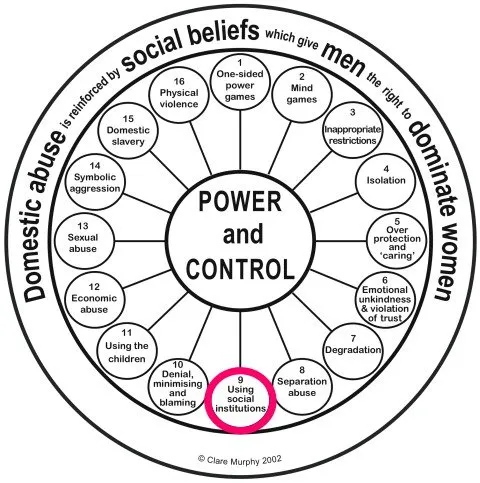
Power & control wheel #9 Clare Murphy PhD
Many perpetrators of psychological abuse use social, health, legal and other institutions such as child protection services as arenas to further their coercive control over their intimate partner.
They use the legal system endlessly to stop their partners from leaving, or to stop them from moving town or country, they do dodgy things to implicate their partner so she will get a criminal record, and perpetrators with financial resources engage women in drawn-out, frequent court battles over property, or over day-to-day care and contact with children. They also use loopholes in the government agency system to avoid paying child support and many use religious ideologies as a tool to keep women and children in line.
Perpetrators who use coercive control also use male privilege and entitlement believing that they “own” their partner, that she must obey and serve them. The good news is that some perpetrators seek help to stop abusing their partner by attending stopping violence programmes. The bad news is that many men then use that programme to further control women. I’ll explain what is meant by all of this below.
Of all the women I interviewed for my Masters research, Adriana had experienced the least amount of psychological abuse. However, it was a different matter after she divorced her husband — he threatened to kill her and began to use social institutions as a vehicle to establish power and control over her. Adriana said, “I think what pisses him off is that I was always in control of my life. The only thing he can get at me with is through our daughter, using the system he can control me.”
How is it possible for perpetrators of psychological abuse to use social institutions to further their coercive control when there may actually be good quality legislations and dedicated well-trained professionals who work hard to protect victims of abuse? Well — there are flaws in the systems — which means some policies, legislations and professional practices can lead to colluding with perpetrators by not holding them accountable for their actions, and can lead to blaming the victims. One of the flaws in the system is a lack of staff training in the dynamics of coercive control in the context of intimate partner abuse. Women I interviewed for my Masters research and men I interviewed for my PhD research tell their stories below….

Using the Legal System to stop women from moving town or country

Adriana regretted moving from  the UK to New Zealand with her partner Steven. His controlling behaviours increased when they arrived back into his home territory. After their separation Steven became abusive in the extreme — he threatened to kill her. For hers, and her daughter’s safety, Adriana wanted to take her daughter back to the UK. However, she could not leave “because he doesn’t want our daughter to leave the country, therefore I can’t leave with her. I wouldn’t leave without her, so I have to be here. I’m quite happy and settled here and doing what I’m doing, but my freedom is totally cut down. I don’t have the freedom to even move towns because he would prevent me. I would have to go to court. It would probably take a year before I could move. He wouldn’t allow me to. It’s the court who would possibly allow me to.”
Heather became pregnant when she was in the process of applying for university. She knew she wanted to leave Luke and pursue an education, so was going to have an abortion. But Luke had High Court papers served on her and the hospital to prevent the abortion. This institutional response fueled Luke’s fire, which enabled him to become even more controlling. Heather wanted to take out a protection order, so that if he breached it, the police would have rights to intervene and arrest him. However, the lawyer insisted she take out an “undertaking” instead. This is one way that the legal system fails to protect victims of intimate partner abuse. An “undertaking” is only a promise — it does not give the police legal rights to arrest a perpetrator of abuse when he breaches his undertaking. The legal system enabled Luke to breach the undertaking. He did this by approaching Heatherin the street and also when she dropped her son off at the agency who provided supervised contact. Each time Luke approached Heather he begged her for more contact with their son, he cried and swore at her. Heather had been wanting to move towns with her son to pursue a new life away from the abuse, but Luke used the legal system to prevent her from doing so.

Using the Legal System to fight for custody of children, with the underlying aim of maintaining power and control over the children’s mother

Elizabeth and David attended a mediation conference where an arrangement was made for Elizabeth to have the children three or four days a week and David would have them for the other three or four days. Such shared care is very disruptive and destabilising for children. Elizabeth said no-one was enjoying it. So Elizabeth “tried to talk to David about ‘What can we do about this? Can we try this, can we try that?’ He wasn’t interested. In the end the kids were really unhappy and she just said, ‘I am just not going to do this any more’ and of course it forced all the legal eagles to get together and deal with it.” David was a wealthy professional so had the financial resources to use the legal system to continue to coercively control his ex-wife.
Elizabeth said, “The judge made the decision which was a much more viable arrangement, which David was really angry about. He still wanted to go to court for custody and of course I am on legal aid. I’ve paid altogether over $25,000 on legal fees, $13,000 I still owe. We worked our guts out to try and get some negotiation before we went to court about custody. He would not respond, he would not negotiate. As far as he was concerned he was going to get what he wanted and he was really pissed off when he didn’t. He said, ‘I paid all this money to get what I wanted and I still haven’t got it.’ He was really angry about that. But I think part of him continuing to push for doing everything legally was because it would cost me a lot of money — money that I don’t have.”

Coercive tactics that lead to the victim getting a criminal record

Elizabeth said David took “up this trespass order when the property settlement came through. A few weeks later I was caught up with my car, and I was going to be late, and he was going to be picking the kids up from my place. I tried to get him at work and tried to get him at home quickly but couldn’t get hold of him. So I rang my neighbour to say, ‘If he turns up can you let him know that I will drop the kids at his place.’ I did what I could to get the message to him. He was absolutely furious. So I dropped my kids there and then rang up a bit later to say, ‘I am really sorry about what happened I tried to get hold of you.’ He hung up on me. At that stage I was really angry, because I thought it was important that he and I have some communication because of the children, so I went around to apologise and say, ‘We need to sort something out here, like there are going to be times when one or either of us is not going to be able to meet a time. What are we going to do in that situation? This isn’t going to work.’ But, he called the cops, had me arrested for trespassing. The kids see the cops take me out of what was our home, off in a police car. Anyway I explained the situation to the cops. They said, ‘Don’t worry about it, we’ll go and get your car, we’ll have a word with the guy, I’m sure he doesn’t really want to press charges.’ They came back — ‘Yes he does want to press charges. Don’t worry about it we’ll get diversion, first offence.’ But for diversion the complainant has to agree. He wouldn’t agree to me having a diversion coz he wanted me to have a criminal record. I had about three court appearances, and my lawyereventually got it to the point where, I think he knew David years ago, and he rang off the record and said, ‘Hey listen mate I wouldn’t do this if I were you.’ Eventually got him to change his mind and I got diversion. But he was prepared to take it to the absolute limit.”
Anthony engaged in tactics that wrongfully led Susan to be investigated and prosecuted for fraud. After Susan separated from Anthony she did not have a car so he would take her to get the groceries. Her overlocker was not working so Anthony took it into town.Susan said that when he came home he said, “It’s not worth fixing, but they’ll give you so much for a trade-in if you want to buy a new one”. So Susan agreed. Susan told me: “This is how naïve and trusting I was. He brought me home a new overlocker. It was in his name. He put me down as being his spouse. He put my address as being his address. When he got his cell phone he did the same thing. He put me down as being his spouse.”
Unfortunately for Susan the government department that provides financial support to single parents contacted her saying, “’You know you’ve been living with Anthony while you’ve been on the single parent benefit.’ She said they had all this evidence that said I was with him because he’d put me down as being his spouse. I said ‘I wasn’t with him’, but they said, ‘He used to take you to town. You used to drive his car’. I said ‘Yeah, but that doesn’t mean that we’re together.’ Anyway, I didn’t know the overlocker was in his name until the last time we split up and I got done for fraud. I said we weren’t a couple. Anthony was telling everybody that we were a couple. That really hurts. I thought I’d got out from him, but he’s still doing these things to make it look good. I hated him. I hated the things he’d done to us, to the low level that he’d brought us down to.”

Using the Government Agency that provides financial benefits to single parents

After she was divorced, Elizabeth spent some time on the single parent benefit whilst caring for her children. During that time she was having a casual relationship with a man. When parenting of children is shared, it is inevitable that children chat to the other parent about what happens at the other house. However, many perpetrators of coercive control use children to find out information that they then use as ammunition to continue controlling their ex-partner. Elizabeth said one time when her son came to her place to stay he asked her, “How many nights a week does Stewart stay mum?” Elizabeth said, “Next thing there’s an investigation by the fraud squad of [the government agency that provides the benefit].” The fraud squad asked, “We believe you have a partner now, what’s his name, when does he stay here, is it a relationship?” Elizabeth was angry, saying this government agency “would rather that you were f***ing a different guy every night than seeing one person who was giving you a bit of moral support or having sex once every three months.”
Elizabeth said David’s accusations to the department that provided the benefit meant that “To stay on the single parent benefit was a challenge, it’s happened twice. In fact the first time was when I was doing some odd jobs from time to time, helping a friend with her business. Anyway the next thing I’ve got the fraud investigation people. Pretty much all of the work that I was doing I was declaring, and the next thing I’ve got them on my case, ‘Did you do work at this place, did you sell this, do that, dah, dah dah dah dah?’ If I did cleaning jobs the kids used to come with me. They told David and David collated all the information that the kids got and gave to him and sent it to the government agency.”

Using the Government Agency that manages child support payments by separated parents

After couples separate, perpetrators of coercive control often find loopholes in the system and use that gap to pay minimal money towards supporting their children, or they may pay nothing at all. Men I interviewed for my PhD said not all men have a problem with paying child support, but some men do. Some controlling intimate partners do not have the best interests of the children at heart. As James said, many men believe “they’re controlled by a government agency over the kids that maybe they feel they own themselves… It’s a loss of control thing, their own personal property.” Lazarus knew the loopholes in the system. He said, “as soon as they start taking money out of my wages, I quit and change jobs … probably every eight months.” This, meant the system’s policy did not oblige him to pay for a period of time. Children involved in such a climate of control are negatively impacted in various ways, for example, not being able to afford to attend school camps and so miss out on healthy social bonding, physical challenges and may develop anxiety, depression or delinquent behaviour problems.
Some perpetrators of coercive control threaten their ex-partners by telling her that if she pursues child support payments from him, he will use the legal system to push for shared custody of the children which would then mean he would not be obliged to pay child support. This is frightening for women victims of coercive control because most women will do what ever it takes to keep their children safe. In their book, The Batterer as Parent: Addressing the Impact of Domestic Violence on Family Dynamics (SAGE Series on Violence against Women)Lundy Bancroft and Jay Silverman draw from their clinical work with men that shows many perpetrators of intimate partner abuse do not engage in healthy fathering practices and many push for custody or contact with children partly as a tactic of maintaining control over the woman, not because they want to develop a warm relationship with their children.

Using Child Protection Services to coercively threaten the children’s mother

Susan said that, “One time Anthony rang and said that a child protection social worker rang and wanted him to go in. When he came back he said someone’s reported that our daughter’s been sexually molested. He said, ‘It’s your father.’ I found that really odd that they didn’t contact me, that he had to just go in without having a set appointment time and that he could take our son with him. Anyway I said, ‘So you don’t want dad looking after our daughter?’ He said, ‘No that’s alright, but they’re going to contact the kindy’. I was absolutely distraught because my dad has a lot to do with my kids. I fully believed Anthonyknew what he was bloody saying. I went to the kindy and asked if they’d been contacted by the child protection service social workers. They said, ‘No’ and would let me know if they were. When I did talk to the social worker she said, ‘We had an anonymous person whose given the names and ages of the children.’ The ages weren’t right. She said it was a man. She said, ‘We don’t follow up on these ones they’re very low priority’. It pretty much wasAnthony that was doing this, because if there’s an investigation saying that my father’s molesting our daughter, then what happens, the kids get taken away. Of course he fully denies that he’d done it.”
Luckily, in Susan’s case, the child protection services did not remove Susan’s daughter. However, many perpetrators of coercive control threaten their partners saying they will inform child protection services that they are an unfit parent. Unfortunately sometimes the child protection system colludes with perpetrators and engages in mother blaming, partly because of a lack of staff training and understanding of the dynamics of coercive control.

Using Religion to establish and maintain power and control

Some men use religious ideologies to justify controlling their partners, by for example telling her she has to obey him because the Bible says so. They may use religion to stop their partner from leaving by saying that God does not allow divorce. Eva Lundgren (1995) interviewed fundamentalist Christian couples in Scandinavia. One man believed that keeping his wife in line was very important because it meant keeping the “pattern of nature” and meant he was following God’s plan. Part of the men’s aim for using the Bible as a guide was to enforce rigid gender roles for women, so that the more feminine they perceived their partners to be the more masculine this made them feel — a feeling which makes some men feel more strong, secure and superior.

Using Social Prejudices as weapons to degrade and control women

Some perpetrators of psychological abuse use social prejudices to reinforce their power. They may do this by drawing on a range of social hierarchies. Social hierarchies only exist because people decide who is superior and who is inferior. Here’s what I mean….
He may draw on the gender hierarchy that men are more superior than women and tell their partner she deserves abuse because she’s ‘just’ a woman.
He may draw on the race hierarchy that ranks white people as ‘better than’ and tell her she’s ‘just’ a Mäori, or ‘just’ a Black woman, or ‘just’ an Indian/Aborigine/Hispanic, and so forth.
He may draw on the hierarchy that classifies some age groups as having more rights and privileges, saying she’s ‘just’ a kid.
He can find many social messages that place him at the top of any hierarchy related to work and finances.  He may be a breadwinner, earn more money than his partner, have wealth in his extended family, work as a lawyer, etc. — such positions are accompanied with kudos, status, respect and a sense of entitlement. She may engage in activities classified low on the hierarchy such as be a ‘stay at home mum’, do volunteer work, or work in paid employment as a cleaner — such positions tend to afford less respect and can be viewed as inferior…. In these circumstances, some men use their socially superior position to degrade, use and control their partners. They may do this by saying to their partners: “you don’t have any right to make decisions because you don’t have a ‘real’ job”, “you’re ‘only’ a mother”, “you have no money so you’ll get nowhere without me”. Then if a woman is dependent on her partner financially and she leaves him, he may further abuse her by engaging her in repeated and lengthy child custody and property battles, or may refuse to assist her and the children financially. Such unjust degradation can make women vulnerable to ongoing coercive control partly because what their partner tells them makes commonsense, because so many people have not learned to critique socially constructed concepts such as social hierarchies. The idea of equality between spouses flies out the window.
Other social prejudices perpetrators draw from include hierarchies relating to physical and psychological abilities — they may say to a disabled wife: “you will never amount to anything, you can’t even walk out the door”. Or they may use body image as a source of degradation by calling their partner “a fat slob”, and they may call a partner who does not have high level of education “a dumb bitch”. As Victoria points out below, all of these comments reinforce messages that surround all of us all the time.
Whenever Graham made snide remarks about Victoria’s size, he’d trivialise the negative impact on Victoria by saying, “Oh but it’s only a term of endearment”. Victoria said “I knew I was big, so it destroyed me a little bit more”. To cope with the abuse Victoria said, “I didn’t try to change my size because my weight is about safety. If I am overweight, I am fat, if I’m fat I’m ugly, if I’m ugly I’m safe, so I eat to keep safe. If you stop eating, you lose weight, people say ‘oh you’re looking good’, then you get abused. I ate because I was hurting. To get over the pain I eat.”
Some women learn that if they challenged their husband’s controlling behaviours, this would cause him to find more and more ways to maintain control by degrading them.

Using Social Prejudices that stigmatise mental illness

In our society, being healthy and well is considered worthy of praise, while having a mental illness and taking medication such as antidepressants is often stigmatised. Some people use these unjust social ideas as weapons to abuse and control others — by attempting to sway how the victim perceives themselves. Perpetrators who are hell-bent on diminishing their partner’s wellbeing may attempt to convince her that she needs a psychiatrist, or threaten to have her hospitalised for a mental illness. During the course of her seven year relationship with Dylan, Sally became  depressed as a consequence of his incessant controlling behaviours. When she started taking antidepressants he said to her that her depression was the crux of their relationship problems. An effect of intimate partner coercive control can lead to the victim feeling as if they are going crazy — feeling as if they’re going insane or have indeed gone mad.

Using Women’s Immigrant Status as a weapon of power and control

Immigrants are vulnerable to abuse by their partner because they may not yet have a work permit, they may lack language skills in a foreign country, they may not know what services are available to them or how the systems work. Many women are sponsored into the country by their partner, which increases her dependence on him. There are various loopholes in the immigration systems that leave women who are victims of domestic violence very vulnerable and powerless.
Perpetrators use women’s immigration status as a weapon of control. They may constantly threaten to cancel their sponsorship of her, they may refuse to help her fill in the forms to get an extension to her work permit, some men threaten to have her deported and they use the legal system to get a court order preventing the removal of the children from the country. Thus children are left in the care of the abusing parent and grieve the loss of bond with the non-abusing parent who has been deported. Some perpetrators cancel their sponsorship, so that the woman’s application to reside in the country cannot go ahead. One Chinese woman, in a New Zealand study of women’s experience of Protection Orders, said her husband repeatedly told her, “I’ve been in this country for so long I know how things work. ‘I am telling you …’” Whenever she contradicted him he would yell: “You stupid Chinese. I’m going to call the immigration service right now and you’ll be out of here!” (Robertson and colleagues 2007:191) Some men will say to their partner ‘what do you know, you weren’t born here’, or ‘you can’t even speak English properly’. Such statements may not sound degrading to an outsider, but in the context of ongoing power and control they are statements that punch hard at immigrant women’s emotional wellbeing.

Using Male Privilege and Entitlement

Men I interviewed for my PhD talked about the kinds of privilege, entitlement and accompanying beliefs that drove their controlling behaviour towards their partners. These beliefs included the idea that men ‘own’ women, and that women are possessions who should serve and obey men. For example, Bill said:
“I can do what I want but you gotta do what I tell you to. That’s the way I’d see 90 percent of marriages, from a man’s point of view.”
Many couples have their money, house and car in both spouses’ names. Regardless of this, as Elizabeth and Sally said, their husbands used to repeatedly say the money, house and car belonged to them and not the woman.
Elsie said, “I was just something that he owned in every facet, whether it be sex or when friends are there, or if I was cooking, or doing some work, or whatever, it was nothing. Nothing I did was ever valued.”
When Pauline and Chris married, he chose the marriage vows — that led to Paulinepromising to obey Chris. In line with the belief that women should obey men, Chris had sexist attitudes towards all women. Pauline said that when Miss World was on TV Chriswould sit under the TV and look up. She said he had the attitude that all women are “tits and bums”.
Max said women should:
“Do as the man says. We can be very domineering. We want it our way. Our way or the highway, girl.… A lot of men do want to rule the roost, like, ‘I went to work, I paid for f***ing this, I’ve been working all week, get home to this shit’!”
Research with men who abuse women finds that those men justify their abuse by blaming women for failing to serve them as men. Geni, a man I interviewed said, “I would think the majority of men would think the wife is like the doting little servant, slave, there to do everything. But a lot of men come home from work in his suit and drops the briefcase and he expects the beer there and the meal on the table.”

Using Stopping Violence Programmes and Anger Management Programmes to further control women

Thankfully there are perpetrators of intimate partner abuse who seek help to change. Unfortunately though, research shows that many men use stopping abuse programmes and anger management programmes as yet another avenue to control their current or ex-partner. The ways men do this include telling her how lucky she is because his behaviours are “nothing” compared with other men’s, or by misinterpreting the training and twisting the definition of what constitutes coercive control by telling her that her behaviours are controlling, or by learning how to use a wider range of control tactics. Men who learn to take “time out” as an anger management strategy, can misuse this by not returning to resolve issues, or they may put the woman in charge of ensuring he takes time out. Many women get confused when their coercively controlling partner accuses them of being controlling. Yes everyone uses controlling behaviours in some form at some time — BUT…. There’s a big difference between destructive and constructive use of controlling behaviours. I write about this in the blog on Denial, Minimising, Blaming, and in my blog on the difference between “healthy” relationships and relationships where there’s “one-sided” power and control.

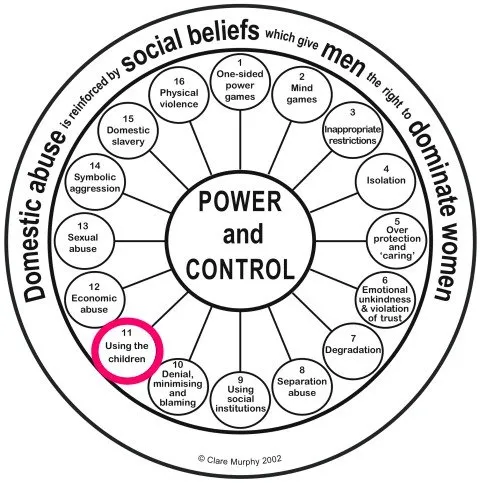
Tactic #11 — Power and Control, Using the Children


Tactic #11 — Using the Children

This is the eleventh of 16 blogs discussing the patterns of tactics from my power and control wheel — Using the Children.Power & control wheel #11 Clare Murphy PhDWays men use the children to maintain power and control or to punish their partner or ex-partner include demanding that she do all the childcare, making her feel guilty about the children, telling her he wouldn’t lose his temper if she kept the children quieter. Some men undermine her relationship with the children, for example when she sets clear boundaries he will then tell the children they’re allowed to do the thing their mother had said ‘no’ to. Some men also undermine her parenting by telling her she’s a bad parent and by purposefully belittling her in front of the children.
Some men use the children by threatening to take them away or kidnap them if his partner leaves him, or they threaten to have the children taken into care of child protection services or they threaten to harm the children, or actually do harm the children.
Women with children are more likely to be abused by their partner than are women without children.1 When men do abuse their partner this increases the likelihood he will abuse the children — physically, sexually, psychologically. And the more frequent the abuse towards their partner, the higher the chance the children will be abused too.2
Many men who coercively control their partner use children as weapons to get at her, control her, and keep her in her place.
Quite soon after starting her relationship with Luke, Heather did not want to be with him because he was abusing her. She wanted to leave and do her teaching degree, however she got pregnant, but did not want to share a child with Luke, so she told him she was going to have an abortion. However, fitting with his possessive attitude, he did not want her to have an abortion so he served High Court papers on her to prevent her from having an abortion. However, as Heather said, “He actually dropped the court case. I just got to read the papers recently through the hospital because he tried to sue the hospital as well. I thought he was so powerful and I just couldn’t mess with him. Even when I had our son he said in one of the affidavits that ‘she’s going back to work, that she obviously doesn’t want our son, so I’ll have him those times’. So if I went back to any work of any sort of description where he thought I was neglecting our son he would be on me. I never went out because he’d say, ‘you’re not going out leaving our son with your parents’. Yet he would never offer to look after him while I went out.”
Despite Luke seeming to want to have a child, this was not his actual motivation for trying to prevent the abortion. Many men with possessive attitudes use the children to maintain power and control over their partner. Heather discusses Luke’s attitude after they separated: “He made comments like ‘I wish you loved me like you love our son’. If I went to town he would grab the pram and say, ‘I know that when I’ve got our son you won’t go far away.’ He’d say, ‘If I had our son you’d come and live with me because you wouldn’t be away from him.’ I went and said to the counsellor, ‘I don’t want to be with Luke’. I said I want it so we have smooth running, we’ve got this child now, I want to get on with my life andLuke to get on with his and sort out some sort of arrangement until our son’s older, whether he comes and visits him at my place, or we meet on a Sunday afternoon until he’s old enough to be taken on his own. I want to remain friends so it’s easier for our son. But thenLuke had me on his own and said ‘there’s no way we can be friends. I’m not going to be friends with you if you’re not going to live with me’.”
Pauline describes how Chris used the children to manipulate and maintain control over her, claiming that he could not spend time with his children because he’d rather spend time elsewhere. Pauline said Chris wouldn’t agree to an access order for the children, so when they were in the Court, “he said, ‘No court or judge is telling me what to do.’ So we had it on agreement and he walked out of court and he turned around and said, ‘Stick your fucking agreement.’ He said, ‘I can’t have the kids, I want to go to Rotary gatherings.’ Contact with the children has been very much to his timetable.”
Many men use the children in an attempt to punish their partner. And the children are negatively impacted as a result.
Raewyn also discussed how her husband Brian would use the children as a tool to prevent her from getting her needs met. Raewyn said, “Once I’d left he would play games about having the children because he knew I wanted a break and he would almost bribe me and say ‘Raewyn let’s talk about marriage and why this has happened and then I’ll see if I want to have the children’. He’s still doing it now. He’s using the children to get at me and they suffer. I suffer because I don’t get my break, but they suffer the most because if he’s not happy with me he doesn’t have them. It’s not so bad but he doesn’t have them very regularly. He could go a whole school-term and not see them. I know he does this because he told a mutual friend of ours because she asked him ‘why don’t you have the children regularly every second weekend?’ He said, ‘No way I don’t want to make it easy for her, so she can have a nice weekend with her lover.’
Susan said, “I had applied for a protection order, but my lawyer was so slow and didn’t think there was anything to worry about. But Anthony had left a suicide note and he left it to the kids. I read it before the kids saw it. I was a nervous wreck. Imagine if the kids had seen this and what it would have done to them. Anthony doesn’t give up. I ended up going to a women’s refuge because I didn’t feel safe at all. I spent five days at women’s refuge. I had to take a week off work. The kids were so confused about things. They weren’t happy being there. I said to him I can’t go on, I’ve found myself a house to rent.” But Susan lived in a rural area and had no transport, so the new house was close which meant Anthony could see it. Susan said, “it was the only empty house there and I had that thing that I had to have the kids close to him because he’d say, ‘My kids have to be with me or else I’ll fight you for custody’.
Men who use coercive control against their partner, know the woman’s vulnerabilities. The love and protection that many women have for their children is one area that those men use after separation to continue coercive control.
After Raewyn left Brian, “He actually went away, overseas, for quite a while, ten months, so it was all pretty quiet. I didn’t realise how blissful that was.” However, when he returned, Brian would use conversations about the children as opportunities to abuse Raewyn.  Raewyn said, “if I rang him up to see if he wanted to have the children, he’d always have a go at me, every time. A lot of the time I was crying at the end of the phone conversations, or I’d get so mad at him. I don’t know how he does it, he just makes you feel bad. I just can’t stand him, and then it would happen the next time and the next time, because he would never say, ‘yes I want to have the children and I want to be a father’. No, no, it would be ‘Oh, you’re just using me for a babysitter.’ So the abuse was just as bad as when we were married. It was revolting. The children are still something he can get at me about, although I’m trying to not get sucked into that one.”
Some men who engage in abusive, controlling, or violent behaviours towards their partner also directly maltreat their children.
Raewyn said that although her husband never really had that much respect for her, the abuse and coercive control got worse once they had children. Raewyn said, “When the eldest boy Paul was two years old, suddenly I felt something different, I thought what’s happened? He’d stopped bugging me and he was abusing Paul. I got scared. I thought at that time, ‘I’ve got to go, I’ve got to go.’ He was really horrible. That’s probably the mostscaredest and the most I ever wanted to leave was at that point. When my son Paul was about five or six, I said to my sister, she was visiting, I said, ‘I’ve got to leave him for Paul’ssake’. She even agreed with me there, for Paul’s sake you’ve got to leave him Raewyn. And again it was like I was locked into it I couldn’t go, I just didn’t know if I had it in me to go.”
Other men who abuse their wives, may also control the children.
Raewyn gives an example of how her husband favoured one child over the other. For some children, this can create rivalries between them. Raewyn said that after she and Brianseparated, “he went back to picking on me and he was also picking on Paul. And his abuse went a little bit further, because he would dote on the youngest boy, which would make it even worse for Paul. I would just be crying inside for Paul because it was so obvious. That was horrible. I think what he was doing with the children really pushed me most to get out. The way he was treating Paul, he would know that it affected me badly. I got to the point where I used to say ‘stop picking on him’, and he knew it affected me. I think it made him do it more.”
Women with children are at higher risk than childless women, of being abused after separating from a man with a history of controlling behaviours.
When Adriana and Steve separated he threatened to kill her and he used their daughter as a pawn to control Adriana. As a result of the threat to kill her, Adriana worried how that threat would affect her daughter. She believed her daughter may be at some level of danger when she was in his care.
Adriana said her ex-husband tries to get their daughter to make a choice between them. She said it must be very very hard for her daughter to cope with his slurring at her and the family. Adriana said, “I have no control over it. There’s no way I can do anything about it, except, again be the rock, be the person who does things the right way. Being the rock means supporting her in what she wants to do, being consistent with my parenting, to be consistent with her, living ongoing in a predictable way, loving her — for me all the normal parenting things. Not saying negative things about him in front of her.”
Adriana said her ex-husband, “was a great father when we were married, but after the divorce he fails to be a father or role model to our child. He fails to be consistent about seeing her. He doesn’t support her on any level I can detect because he doesn’t support all her interests, he jeopardises all her interests. He doesn’t support her financially in any way. He uses her for his own purposes which I think is the lowest of the lowest. For example he uses her as a negotiator between us, he buys her presents and does not let her bring them home or use them.”
Many coercively controlling men (especially if they have money) use children to battle for contact or day-to-day care in the family court.
Research shows that many of those men are able to put on a charming façade when outsiders observe their fathering. Adriana said, “The court system is quite steadfast on any access. The court believes any relationship with the father is better than no relationship — even if it hurts the child. Not necessarily physically because he hasn’t been physically violent. We had a couple of psychologist’s reports and the psychologist looked at the way he behaves towards her for an hour and made an assessment of that. The report showed nothing like the reality. It didn’t show things like the fact he calls her up and asks whether she’s slim or not. But again I had no control over that because he is her parent, he is a guardian so he has amazing power not only over her, but over me and it is given to him by the legal system and by the structure. There’s the hard bit because there’s no way as an individual that I can fight it. He’s got the right to make decisions for her, which obviously influences my life.”
Elizabeth said that, David “took out custody proceedings yet there was no way he could look after the kids” because as Elizabeth said, she had “looked after them all the time that we’d had them. They were little children.”
Using the children in this way to maintain control over Elizabeth was despairing for her. She said that David “had these people he called nannies, they were just girls that he had picked up wherever he picked them up that he called nannies. I remember one holiday I dropped the girls around there so that he could pay a teenager to look after them while I went out cleaning. The whole thing was just so back to front. I would say, ‘I’ll look after the kids. I’ll have the kids.’ ‘Oh no no.’ There was no way he was going to let that happen. We went to mediation, we went through the whole legal process, and to mediation for custody of the kids, and the kids had lawyers and the kids had psychological reports and that whole business — which was very hair raising. And he has this wonderfully charming persona, he is very proper and very charming and of course he’s got his professional life and his lovely home and here I am scraping to stay alive.”
Many men who abuse their partners, show a lack of responsibility as fathers.
These fathers lack interest and involvement and do not fulfill the huge range of parenting tasks required. Instead, the mother often has to take up the slack and do all the things for the children that the father neglects to do, such as organising school camp, all the equipment and logistical arrangements that go along with that, organising school uniforms, medical appointments, ensuring medication is administered on schedule, ensuring children have a balanced healthy diet, and so forth. Many men who control their partners just want the public kudos of being a father, but not all the hard work that committed healthy parenting requires.
Elizabeth said, “When I left, I stayed at my girlfriend’s. The children were living in the house where he was living. I used to come in at seven o’clock in the morning to seven at night to look after them, as we had four children at that stage and the youngest was three. He used to leave me lists of things to do, I had to do this and I had to do that. If I went to the supermarket to buy food he wanted to see the receipt to make sure that I hadn’t bought anything for myself. I couldn’t get onto a benefit because even though I was looking after the kids 12 hours a day, because they were sleeping at his house, I couldn’t claim a benefit, because technically they were in his care. Not that I was really into looking at benefits at that stage, because I never saw myself as someone who should be going on a benefit. I couldn’t claim child support because again they were in his custody, that is where they spent the night is the thing that counts.”
Children are impacted in a variety of ways when their father uses them as a tool to control their mother.
How children are impacted depends on their age, the kind of control and manipulation they experience, the strength of bond they have with their father, mother and siblings and the degree to which their father undermines those bonds. Children’s needs for psychological and physical safety may be diminished, their ability to focus and enjoy school may be impeded and some children may develop physical illnesses. Children may try to stop the abuse, while others may feel powerless to change anything. Some children become confused, anxious or depressed. Yet other children may be very resilient — especially if they have good stable supports and they are able to talk to trusted family, friends or people in the wider community about what they are experiencing.
Watch out for blogs on the following control tactics:
References:
  1. Humphreys C. Domestic violence and child protection: Challenging directions for practice. Australian Domestic and Family Violence Clearinghouse: Issues Paper 13. 2007.
  2. Baker LL, Cunningham AJ. Helping children thrive: Supporting woman abuse survivors as mothers. London, ON, Canada: Centre for Children & Families in the Justice System, London Family Court Clinic, Inc., 2004.

Post-Separation Abuse Featured in the New Duluth Power and Control Wheel

Post-Separation Abuse Featured in the New Duluth Power and Control Wheel

*Chris Godsey lives, teaches writing, and works as an ally in the movement to end men’s violence against in Duluth, MN. He can be reached at cgodsey@d.umn.edu. Renita Robinson is a Trainer with DAIP on post-separation violence, and the Executive Director of the Committee Against Domestic Abuse(CADA) in Mankato, MN; she can be reached by email: renitar@ inspire-hope.org/.
This article appeared in Domestic Violence Report, August! September 2013.

In this article, authors Chris Godsey and Renita Robinson describe the Duluth Post-Separation Power and Control Wheel, which depicts the commonplace tactics used by batterers to continue their battering during the post-separation period. These tactics typically involve the manipulation of the children and of the mother’s relationship to them.
Any reader who is familiar with domestic violence custody cases is likely to recognize these strategies in cases they have seen.
Since the post-separation period is the most dangerous time for a victim, it would seem exceptionally important for battered women, along with their lawyer and other allies, to be able to recognize these tactics and do everything to put a stop to them before the batterer is allowed to continue wreaking emotional and psychological havoc on the victims and their children.


Battering survivors, their advocates, and many practitioners know that when a woman escapes a man who abuses her, she and their children usually face intensified dangers. Experience tells them that he will begin using their children, the effects of his past abuse, and his potential for more violence as tools in new forms of force in his efforts to engage systems and institutions in maintaining power and control over her.
In more than 20 years of working to protect battered mothers and their children while holding fathers who batter accountable, the Duluth Family Visitation Center (DFVC) has become well-versed in articulating and accounting for post-separation violence dynamics. DFVC is a division of the Domestic Abuse Intervention Programs (DAIP), the organization that in the early 1980s developed the Duluth Model philosophy for responding to domestic violence and the original “Power and Control Wheel.” The Model and the Wheel are now international standards for people and organizations working to understand and end men’s violence against women. DFVC is responsible for supervising and carefully documenting visits and exchanges among violent fathers, their children, and mothers who have survived abuse. This task puts DFVC employees in a unique position to identify tactics that can be easy to miss or misconstrue, and to help other practitioners to better understand these dynamics. DFVC developed vocabulary that eventually became the “Using Children Post Separation Wheel” while supervising visits between fathers and children and working with mothers in their Safe Transitions Healthy Families Program and their Strong Moms and Safe Kids support group.


https://docs.google.com/file/d/0Bx4GGUn1iG7dSVZTTnBoTDQyQzQ/edit


Paper Abuse: Documenting New Abuser Tactics

Paper Abuse:
Documenting New Abuse Tactics
by Susan L. Miller and Nicole L. Smolter*
Editor’s Note: In this piece, Susan L. Miller and Nicole L. Smolter describe “Paper Abuse,” a common form of intimate partner abuse that operates within the venue of the legal system. Sometimes referred to as “legal abuse,” a term popularized by Dr. Karin Huffer’s book Legal Abuse Syndrome, paper abuse encompasses repeated filings of frivolous, vindictive legal motions by abusers and their attorneys solely for the purpose of wearing down their victims financially and emotionally. This commonly reported experience causes enormous stress on victims who are already suffering the trauma caused by their earlier interactions with their batterers and who must now have contact with them via the legal processes and appearances demanded by the abuser’s baseless motions.
A
s most victims/survivors, victim service advocates, and other professionals know all too well, it is naive to think that abuse ends once a violent relationship is over. In fact, research reveals that battered
women are at higher risk of serious injury or death following the termination of a relationship (Tjaden & Thoennes, 1998). In addition to the heightened risk of physical violence, many victims are also subject to other forms of abuse as well as stalking (Mechanic, Weaver, & Resick, 2000). “Paper abuse” can have debilitating consequences and needs greater attention. This concept incorporates acts that are routinely used by batterers against their former partners to continue victimization and includes a range of behaviors, such as filing frivolous lawsuits, making false reports of child abuse, and taking other legal actions as a means of exerting power, forcing contact, and financially burdening their ex-partners. Legal venues, including protection order hearings and divorce and child custody proceedings, are particularly ripe for paper abuse not only because they involve multiple meetings and hearings but also because these types of cases are often heard by multiple judges. In this often lengthy process, histories of abuse can be ignored, forgotten, or distorted by the abuser. Victims are also often legally required to participate in these proceedings and, when they do, may have few resources for protecting themselves. We suggest this element of forced contact restricts victims’ access to protection and creates ongoing hassles, burdens, and frustrations. Thus, despite the lack of physical violence, paper abuse should be recognized as an example of continued victimization.
https://docs.google.com/file/d/0Bx4GGUn1iG7dM1hzdzNmRnF6UUU/edit


Tuesday, October 7, 2014

TAKE ACTION This October - Instead of The DV Awareness (Useless Feel-Goods) Month


Again, we can stop this..... Question is do we want to? This Book is under $20.00. Absolutely every victim/ survivor/ advocate/ city council, DA, State, AG, and it should be in EVERY University and Public Library in this Nation!

I want this to be the standard read when it comes to intimate terrorisim. Simple, money gaining vs. costing, the only way that it would even be possible to continue these horrible human rights atrocities is by those powers that be.... Society can now be outraged and DEMAND, without repercussion, armed with the facts, the easy truths in resolving humanity's basic human rights to freedom, to safety.
And, it is simple common sense that will GAIN $$ - not need more $ tossed at it.

http://www.amazon.com/The-Quincy-Solution-Barry-Goldstein/dp/1934759864


Would you like to share a $500 billion reward?  It might sound too good to be true, but this is the benefit to society of adopting the Quincy Solution with its proven practices to dramatically reduce domestic violence crime.  Barry Goldstein has spent his career working to prevent abuse so he knew how to synthesize history and research about practices that stop domestic violence with medical research about the enormous health impact from stress related to domestic violence and child abuse.
Barry started by reviewing the successful practices in Quincy, San Diego, and Nashville.  Domestic violence is not inevitable, and it is not surprising it can be prevented with a group of best practices.  He updated the proven practices with new research, technology, and inclusion of the custody courts.  The primary obstacle was inertia and money.  Then the ACE (Adverse Childhood Experiences) research established that children exposed to domestic violence, child abuse, and other traumas suffer more illnesses and injuries throughout their lives.  We can reduce societal problems like cancer, heart disease, substance abuse, and crime—and dramatically improve our economy.  This is the Quincy Solution.
  • Domestic violence is not inevitable.  The Quincy Solution is based on successful practices in Quincy, Nashville, and San Diego so we know it works.
  • The $500 billion in annual savings from the Quincy Solution comes from prevention of illnesses and injuries, reduced crime, and victims reaching their economic potential.
  • The Quincy Solution is more than an absence of abuse.  Women and children will be safe in their homes and free to reach their potential.
ABOUT THE AUTHOR: Barry Goldstein has dedicated his career to stopping men’s violence against women and preventing the mental, emotional and physical trauma it inflicts on their children.  A passionate and sought-after speaker, Barry’s the author of four other books on domestic violence.
“I can’t help but think of all the courageous women who died and all the anguished faces of the children they left behind -- who might have been saved by this book.”~ Rita Smith, Former Executive Director, National Coalition Against Domestic Violence
“Barry Goldstein compiles shocking data showing how our legal system enables violence against women and children.  Buy this book.”~ Wendy Murphy, New England Law Boston, Author “And Justice For Some”
“Domestic violence can be stopped.  This book proves it.”~ Andrew Willis, Survivor, Founder Stop Abuse Campaign
“Barry Goldstein has eloquently captured the crisis that is domestic violence in America today, but his real gift is that of hope.”  ~ Sarah Buel, Survivor, Advocate, Law Professor and former Quincy Prosecutor
“A must-read for advocates, police officers, lawyers, judges and anyone who cares about saving the lives of domestic violence victims.” ~ Lt. Mark Wynn (ret), Nashville PD
“A long-awaited, desperately-needed gift to battered women and their children.  This plan could become the Holy Grail of custody litigation.”~ Mo Therese Hannah, PhD, Chair of the Battered Mothers Custody Conference
“Preventing domestic violence can interrupt the cycle of violence that harms children, families and communities.  It’s critical to use science to demonstrate what works, then move from science to practice.”~ Linda C. Degutis, DrPH, MSN, Former Director, NationalCenter for Injury Prevention and Control, CDC
“Shocked to learn the courts don’t already make the health and safety of children priority one when deciding custody and visitation.”~ Kelly Rutherford
Actress
Sales of this book support the National Coalition Against Domestic Violence and the Stop Abuse Campaign's implementation of the Quincy Model.

Monday, October 6, 2014

Violence: is Just One, of Many Methods Used to Maintain Complete Control and Total Domination of Women.

Despite its great achievements, the Domestic Violence Revolution Is Stalled, Evan Stark argues, a provocative conclusion he documents by showing that Interventions Have Failed to improve women’s long-term safety in relationships or to hold perpetrators accountable.

Stark traces This Failure to terrifying detail how men a startling paradox, that the Singular Focus on Violence against women Masks an even More Devastating reality. In millions of abusive relationships, Men Use a largely unidentified form of Subjugation that more closely Resembles Kidnapping or Indentured Servitude than assault. He calls this pattern coercive control. Drawing on sources that range from FBI statistics and film to dozens of actual cases from his thirty years of experience as an award-winning researcher, advocate, and forensic expert, Stark shows:


"How Men Can Extend Their Dominance of Women, Over Time and    through Social Space in ways that Subvert Women’s Autonomy, Isolate Them, and Infiltrate the Most Intimate Corners of Her Life".   See more at: American Mothers Political Party 


###


Violence:  Just One,  in the endless, and many, in combination with other methods, to Maintain Complete Control, and Total Domination of Women.


I was asked to do a video biography. This was one of the hardest things I have done. It was easy for myself to actually advocate and "just do" what needed to be done, when the time was right. But dig personally back into just myself, taking pieces and trying to timeline backwards, well it just didn't work that way for me. Perhaps it is too painful, perhaps because it does not feel whole without my sisters in unity. (I think that is it).

 Most of my sisters, know that I am on hiatus at the moment. I continue to seek answers, solutions and a wholeness to bring back to, and contribute along with my mothers and my sisters. You see, we all are in this together, our suffering is not just ours, it is humanity's. We know from "gut' instinct, and pure love of heart, that we must change the perception of domestic violence, because it is wrong in every sense.  We must somehow "UN-minimize” it and bring it back around to what it truly is. Because we know from our own personal journeys, that this IS a stripping of our very humanity, our autonomy, our very basic human right to our self.

Of course, October, (our only small, yet minimal, alleged time to speak) about some of the horrors, in the stripping of our humanity, just one of many used against us (violence). That one month, that twenty five years ago was set aside for the color purple, the color that no one "gets",  like the color "pink" does, on the backs of beverages and sugar packages in the stores. Regardless of the fact that the "Leading Cause of Death to Pregnant Women" is from the same dominating monsters/ property owners/fathers/so called intimate others/ boyfriends/husbands.


The Nazi's and the Slave Master’s,  impregnated women the same way. Yet, we remain very much imprisoned and bound by societies accepted cultural norms of treating women worse than cattle.

We are a class of people whose basic human rights to self, to freedom, to life,  have been and continue to be violated, not just by those "slave owners" who sought to dominate us in every aspect of our lives, but by an entire system and social culture that is so very accepting and supportive of the continued oppression of women and her children. One day what has happened to us, will go down in history as one of the worlds worst, mass human destruction.

We are not "domestic", we are not "dispute", we are not "high conflict", we are not just "violence", and we are certainly not "shared parenting" "alienation or any other psych term, coined to maintain control over women and children. Not unlike "draptomania" that was given to slaves when they wanted to be free of their masters. The solution was to beat them severely. Just as now, the solution is to take her children, and make her jump through decades of impossible hoops, to which we do, because of our children. In that strength and in that complete determination, our oppressors have under estimated us. Because you see, it is that very same drive that we will overcome, we will set ourselves free.

 After 20 long hard years, in the trenches, with mothers, my sisters, comrades and friends, who hold each other up, who are sure to never let any voice be silenced, I salute you!


[ohhh and p.s. I remain in my personal boycott of "Domestic Violence Awareness Month" for personal reasons, as I have, the past few years. I think that when WE and not the powers that be, create our own expression and our own truths and our own way to speak, without minimizing the totality of the treatment of women, then I shall sing from every roof top].


The Path Unpaved

(a poem for the Humanist's Path for Freedom & Human Rights)

I've walked this path alone so often,
I know it's form by heart.
And now, as always, my footing's unsure,
on its unstable and rocky start.

I second-guess each step I take,
for fear I'll slip and fall,
That one wrong step will lend me to,
an end that ends it all.

One misplaced foot, one careless word,
an avalanche begins;
The tug of war of heart and mind,
till one of them finally wins.

Each time I've walked this troubled path,
It’s ended  journey not together,
 Each time I fear that to walk it again,
will tear me apart forever.

I haven't the strength to walk it alone,
nor the energy, if only I knew..
As every time I take this route,
I fear it may be my last too.

I don't know how to stop the pain,
Of traveling down this road again.
I've fought it time and over,
only to start it over again.

Yet each and every day I persevere,
As I steady my Unstable start:
I know that only change can come
From all of Passions Heart.

So if I must, I’ll rest awhile.
Ignore the Siren song.
Take comfort in the truth I dare
Unshakably, I will try to stand eternally strong.

© AngelFury - 2005